Physical AI
in practice
From the learning stack and simulation to motion capture and stability under contact - this is how we build humanoid control ready for the ring.
Physical AI Stack
Five key areas that let the robot learn movement, keep stability and carry out tasks under physical contact.
Motion control
Motion policies that let the robot walk, turn, take a guard and react to loss of balance.
Reinforcement Learning
Reinforcement learning that trains the robot's behaviors in simulation before they reach the physical machine.
Motion Retargeting
Analyzing human movement and transferring it onto the robot's body while respecting mechanical constraints.
Sim-to-Real
Validation and testing that minimize the gap between the virtual world and the physical robot.
Physical AI
AI systems acting in the real world - decisions shaped by physics, contact, dynamics and hardware constraints.
Tournament =
laboratory
We treat the fights as a proving ground for technology with far broader use than sport.
From mocap
to the robot
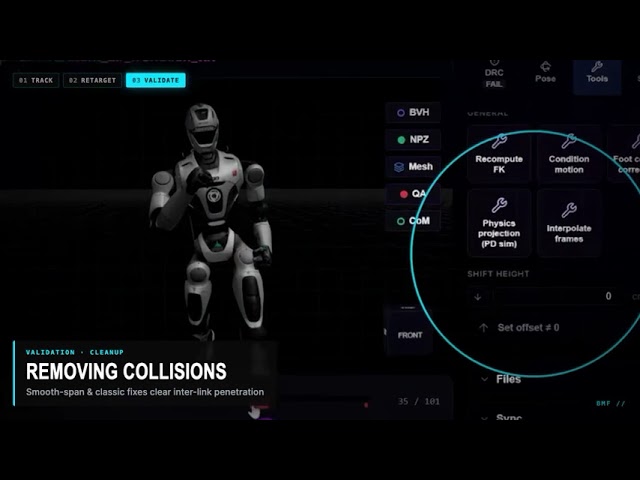
The motion-retargeting pipeline - from a motion-capture recording, through skeleton tracking and verification of posture, timing and continuity, to a movement ready to transfer onto the robot.
Balance, reaction
and recovery
In a physical fight the robot must walk steadily, respond to contact and regain posture after strikes - these three areas define readiness for a bout.
Balance
Walking and keeping stability in guard and after physical contact.
Reaction
Responding to contact, offensive and defensive moves in a dynamic clash.
Recovery
Regaining stability after strikes in an unpredictable environment.